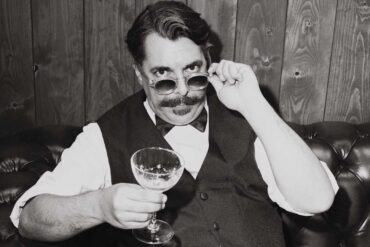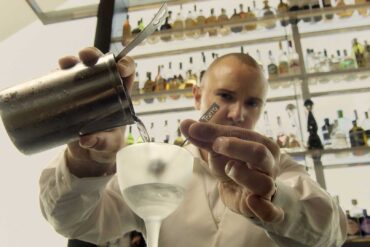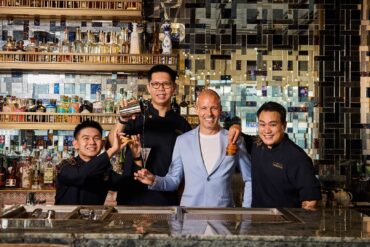

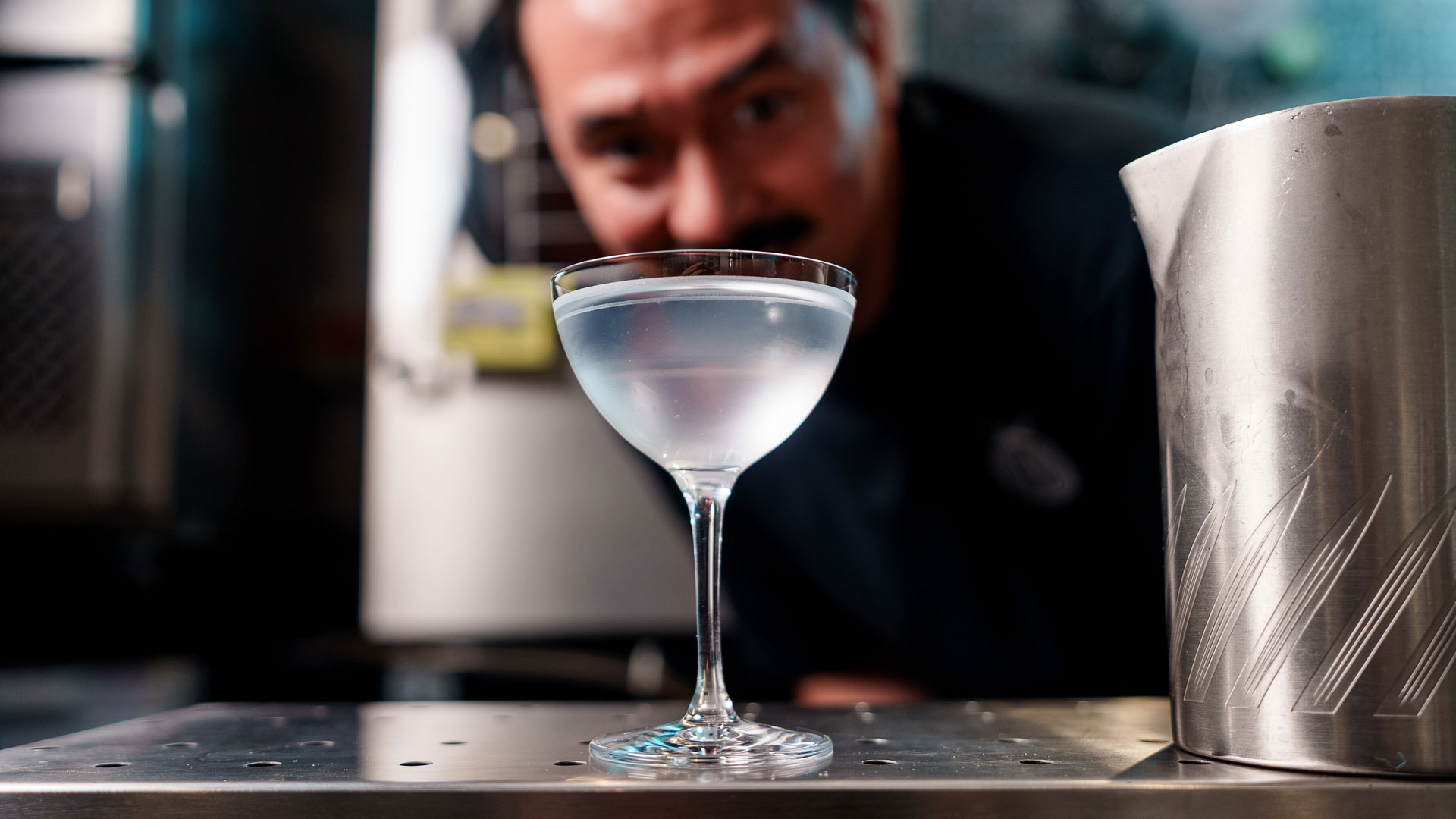
Iain McPherson, founder of Edinburgh’s Panda & Sons, has developed a new technique for cocktail making called Densing. It is designed to blend liquids and oils into stable emulsions, offer precise control over texture, and unlock unusual visual effects — including, for instance, a pink Negroni. The process reduces waste, shortens preparation times, and avoids the kind of investment usually associated with high-end bar technology. Equipment remains relatively accessible, and McPherson’s approach is deliberately open source, making the technique available to anyone interested in exploring it.
What Is Densing?
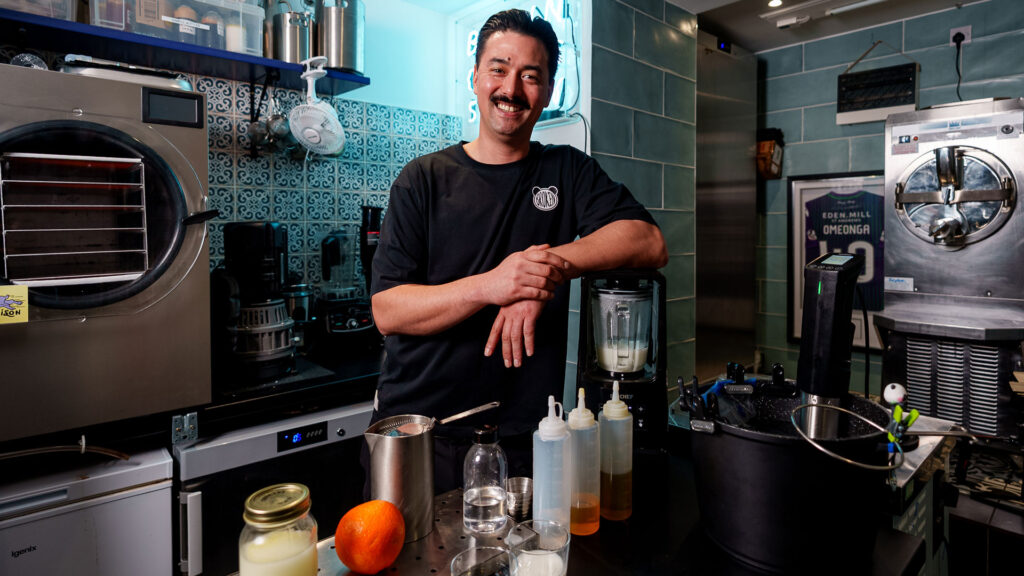
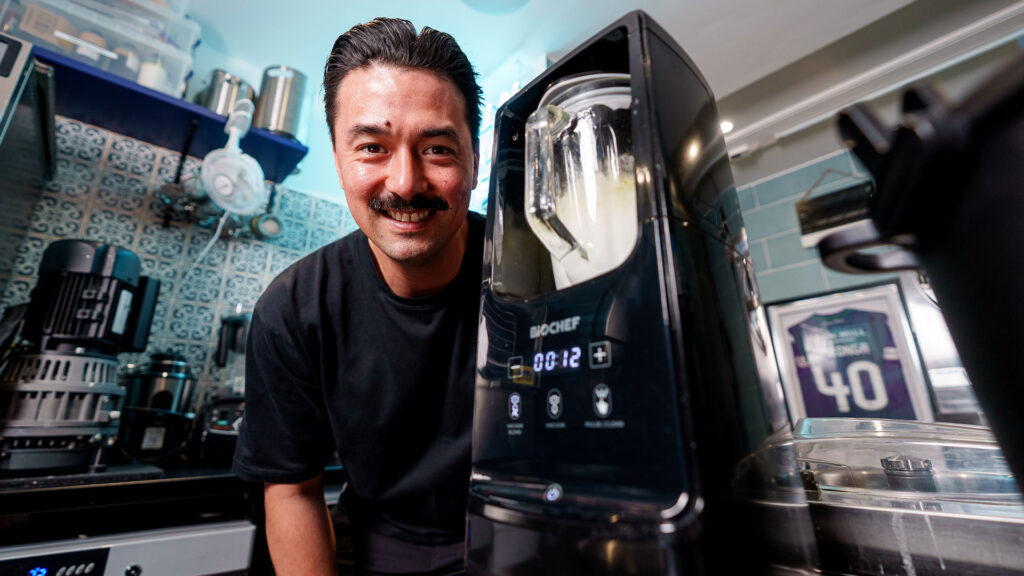
Densing is a technique that uses a vacuum blender to create stable, uniform emulsions between ingredients that would normally resist blending. It draws inspiration from industrial processes used in ice cream and dairy production, adapted specifically for the needs of a cocktail bar.
In simple terms, liquids and oils are brought to similar temperatures, high enough to fully liquefy the fats. The ingredients are then blended under vacuum conditions to create what McPherson describes as “a stable, unified form.” The result is a more harmonious aromatic profile, greater flavour intensity, and a broader range of textures, from light and velvety to rich and creamy, or even purely aromatic.
The Limits and Potential of Densing
McPherson has long been associated with low- and ultra-low-temperature techniques such as Switching and Sous Pression. “We’ve spent more than a decade exploring freezing in relation to flavour. With Densing, I wanted to look at texture in a deeper way,” he explains.
“Densing opens up far greater possibilities when it comes to texture and, in some cases, offers a more stable, faster, and more efficient route to achieving it. We can control how much fat passes into the liquid and, in certain contexts, we can also control the binding process. There is a limit to how much fat a liquid can absorb. Everything has its limits, but we’re still in the early stages of this technique, so there’s a great deal to learn this year and beyond.”
Reducing Waste and Preparation Time
A Densing session takes roughly five minutes. “This technique saves a significant amount of time and requires less labour,” says McPherson. “It increases yield because we can work with between 0.5% and 3% fat, and almost 95% of that is permanently absorbed.”
That efficiency changes the economics of ingredient use. “It reduces the amount of oil required, which can be expensive, and dramatically cuts waste compared with traditional fat-washing, where the fat is discarded and far larger quantities are needed to achieve the desired flavour and texture.”
Playing With Colour, Including a Pink Negroni
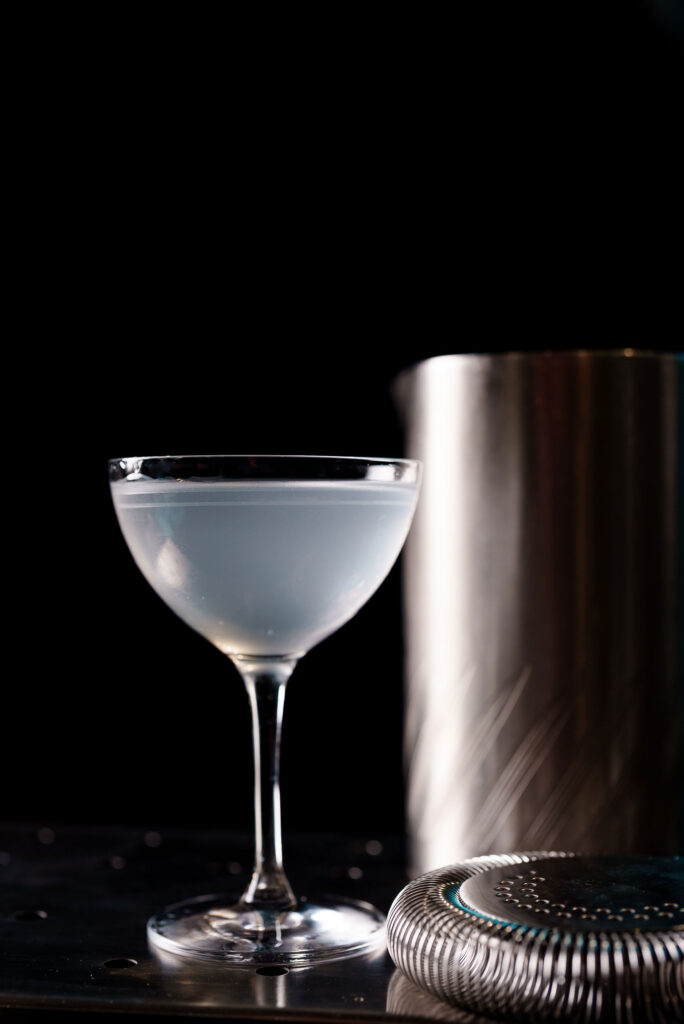
“I love the colours you can achieve with this method,” McPherson says. “When oil remains clear, colours feel sharper and more direct. Densing introduces a whole pastel spectrum.”
One of his experiments involved a Negroni-style cocktail built with olive oil. “The result was a beautiful pink, completely different from the classic red of a traditional Negroni. You can also create a cloudy effect, similar to pastis, absinthe, or non-chill-filtered whisky. It adds a dimension that simply isn’t possible otherwise.”
Why Densing?
McPherson says the technique emerged as a reaction to the dominance of clarified, ultra-transparent cocktails. “That trend often brought with it a similar texture profile and, at times, a loss of flavour. I started asking myself whether cloudiness was really such a bad thing if the drink actually offered more.”
Is the public ready to stop seeing opacity as a flaw and start viewing it as a marker of structural complexity and quality? “I think so, though cloudiness won’t appeal to everyone, just as clarity doesn’t appeal to everyone. Just because we both love music doesn’t mean I’ll enjoy your favourite genre. That’s a positive thing. Variety and different tastes are exactly what push this industry in new directions.”
Is This the End of Traditional Fat-Washing?
“I don’t believe Densing will replace traditional fat-washing,” McPherson says. “They’re different approaches rather than competing ones. I prefer to think of Densing as a ‘full-fat wash.’ They should coexist, because Densing isn’t limited to one specific application. It’s more of a bridge that allows bartenders to interpret cocktails in many different ways, rather than simply being a more aggressive version of fat-washing.”
Affordable Equipment, Broad Accessibility
Even starting from scratch, without specialist equipment, bartenders can adopt Densing without extreme costs. “A vacuum blender is nowhere near as expensive as a centrifuge or a rotary evaporator. It’s priced more like a premium domestic blender, and if necessary it can still function as a standard blender by simply disabling the vacuum setting.”
Accessibility has long been part of McPherson’s philosophy. “Ever since Sous Pression, we’ve developed techniques with bartender accessibility in mind. We want these ideas to be as affordable as possible for the wider community.”
An Open-Source Technique
McPherson has never approached technical innovation as something to be hoarded for competitive advantage. “We’ve never believed in keeping things hidden. If something is useful, we want people to take it, adapt it, and push it in entirely different directions.”
Panda & Sons plans to support that openness with educational material in the coming months, including videos, seminars, and guest shifts around the world. “The first car wasn’t a Ferrari,” McPherson says. “What excites me is the idea of brilliant bartenders exploring entirely new possibilities with Densing.” Eventually, perhaps, someone will build the supercar.
Densing in Practice: The Word of Mouth Menu
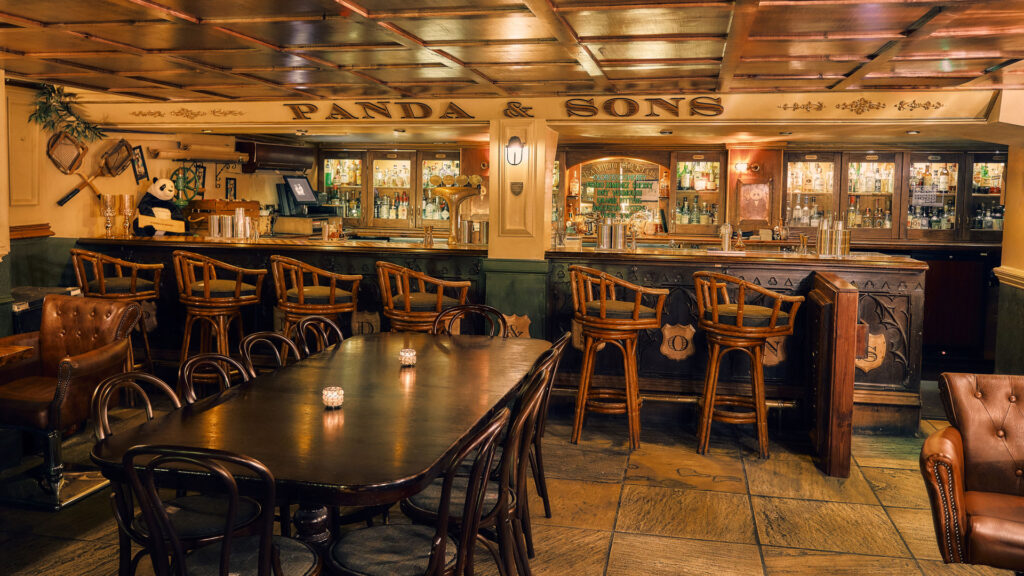
For now, the earliest experiments are happening behind the bar at Panda & Sons itself. “We’re currently serving several Densing cocktails to guests and gathering feedback. We’re keeping flavours relatively restrained because we want people to notice the shift in texture.”
The current lineup includes a coconut Margarita, a clarified butter Old Fashioned, and an olive oil Martini.
“We’ll keep rotating the cocktails as we prepare for the launch of the full menu,” which will be called Word of Mouth.
Images courtesy of Panda & Sons