
Milan has built a durable relationship with the beverage world through the daily work of its bars — places where choices about product and service are constantly tested by an audience with high expectations. Not necessarily more technically informed, but certainly trained to spot the differences — and to demand quality, and speed. That constant pressure has forced people behind the bar to decide quickly and deliver consistency, with no room for error. And yet that very demand has surfaced a new need in the industry: a place to stop earlier, while decisions can still be examined, corrected and rethought — and ingredients can be observed without the stress of service.
Percento Lab in Milan has been working in that direction for five years. It is a creative workshop operating away from the bar, where people study, test, correct — and produce what will later be used in venues: from ice to reworked distillates, from shrubs to cordials, from syrups to sodas, and other tailor-made solutions.
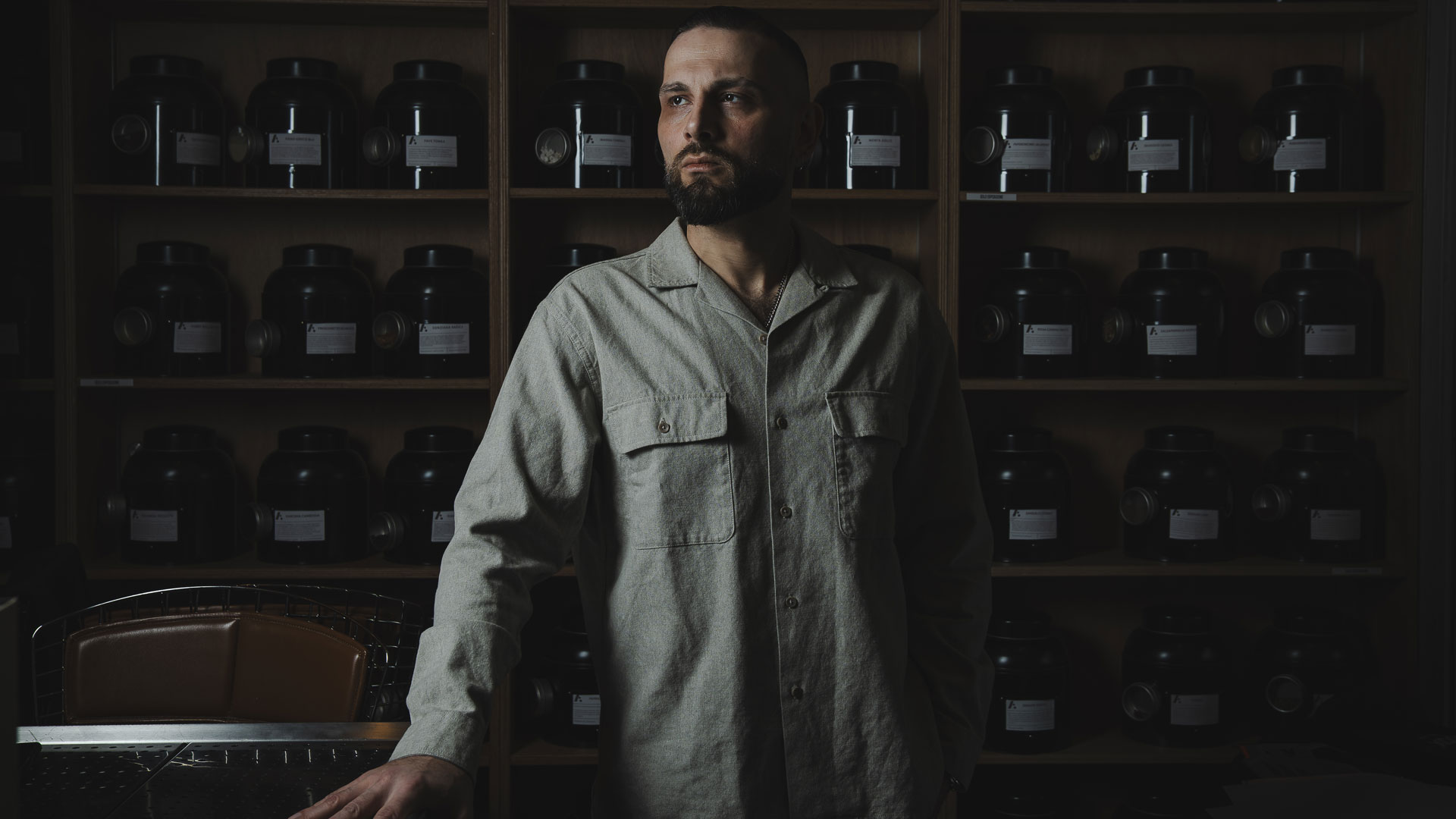
Lucian Bucur, Passion at 100%
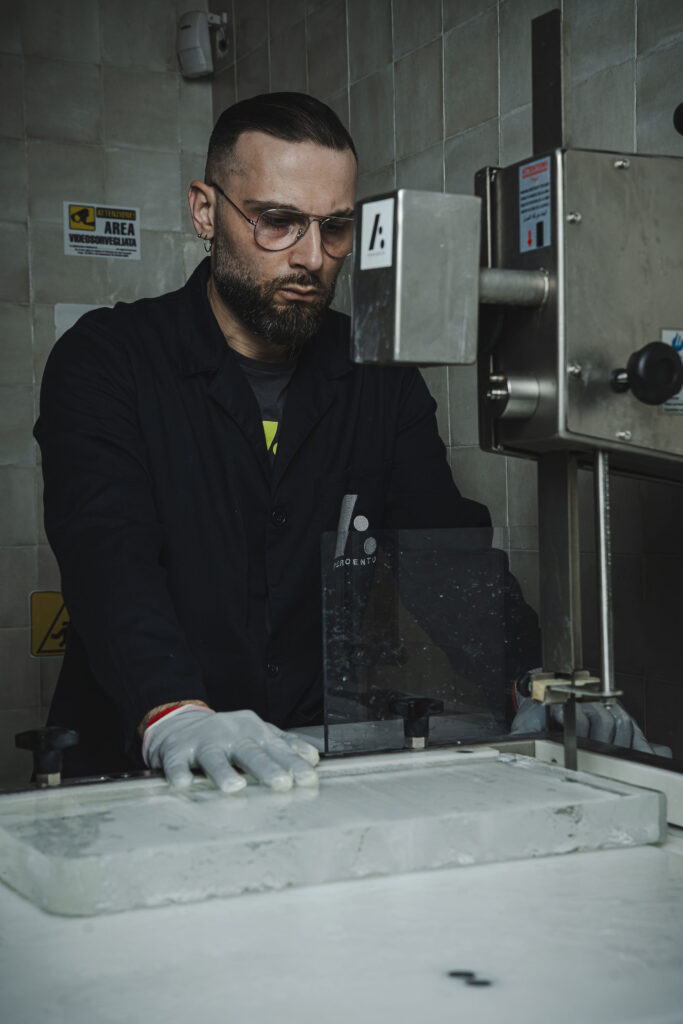
The story of Percento Lab begins in 2021, taking shape as an operational laboratory for the group that includes Bob Milano, Chinese Box and Agua Santa, sparked by an idea from the entrepreneur Luca Hu. From the start, the leadership was entrusted to Lucian Bucur, who moved from the bar at Bob to running the laboratory on Viale Stelvio.
Born in Bucharest, with a background that spans economics and the study of processes applied to beverage, Bucur is bar passion at 100 percent. “Percent means proportion,” he says. “It is the simplest way to control a process when volume changes. If a recipe, a base or a production works once, it has to run smoothly in the same way when you repeat it a hundred or a thousand times. Without losing balance.”
The Percento Lab Method
Step inside the lab and the parallel becomes obvious. The long central table marks the passage between design and execution. It is the work surface where tests are discussed and decisions debated. “It is also a space for comparison and sharing before moving into the machinery area,” Bucur says, pointing it out. The hands-on work, in this second zone, always starts with the essentials. “First, you have to learn how to use a scale, a refractometer. You have to know how to keep time and temperature under control.”
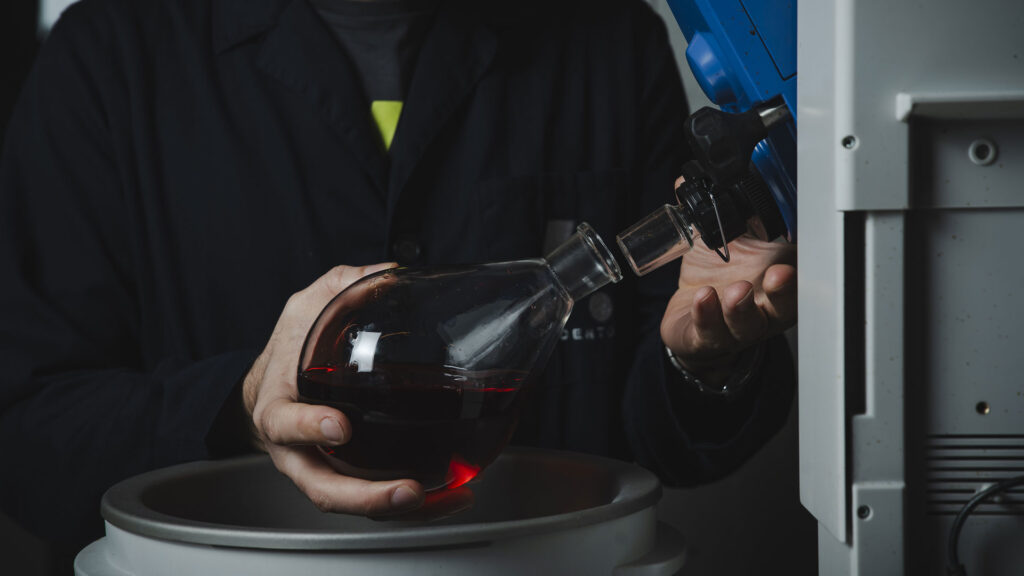
And he insists: “Forget the most sophisticated machines — those come when they are necessary.” Even the rotovap, often seen as the emblem of a certain technical style of mixing, gets put in perspective here. “It is useful, but it is not indispensable. Better to start from the base: a pitcher and a stove. You have to understand what you are doing, not collect machines.”
Even at the lab, among stills, there are centrifuges, chemistry-lab beakers, filter pumps for clarification, ultrasonicators, chambers for producing dry ice — and more. “Companies that operate in sectors far from the bar entrust us with machines designed for other contexts. We analyze them, we push them, sometimes we break them. Only then can we understand the limits. Our work is to translate certain industrial tools into something that can actually function in venues. Of course, we are not a chemistry lab, and we are not pure food engineers. But we come from the bar — and everything we make has to go back there.”
Percento Lab’s Ice Program and Waste Control, Explained by Lucian Bucur
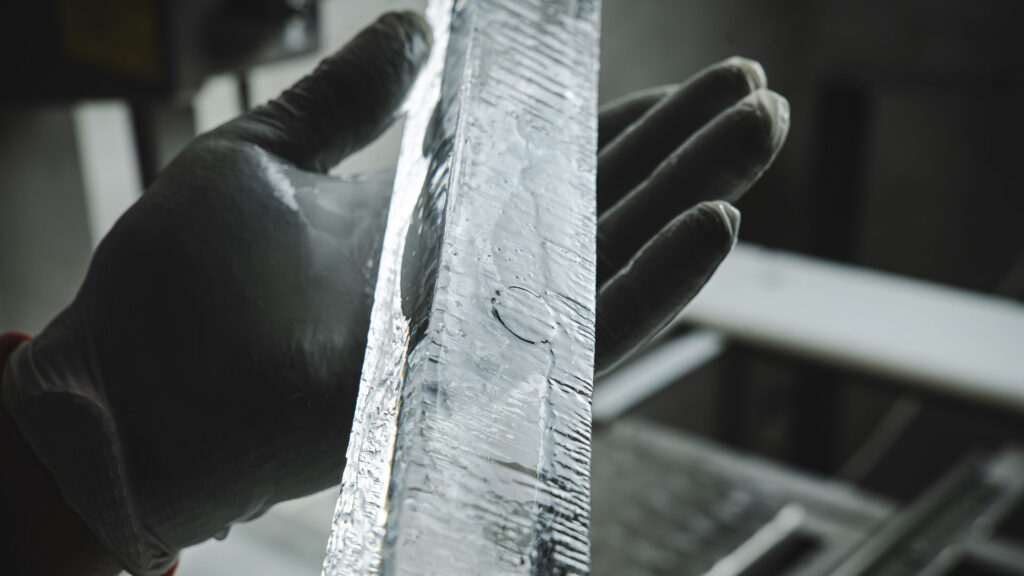
Ice, for example, is one of the most representative elements of the laboratory, both as decoration and as the backbone of service. At Percento Lab it is produced in-house, in blocks, with rigorous control at every stage.
“When I talk about waste that can reach 70 percent, I am referring to how ice is often worked in bars, with improvised equipment and loosely controlled processes. In those cases, a huge part of the block is lost through imprecise cuts and unavoidable scraps. Here the process is different. We produce ice in-house, in blocks designed to be worked on a purpose-built bench, with a food-grade blade that reduces dispersion to a minimum. What melts during cutting is recovered, filtered and put back into the cycle. That is why we manage to recover 80 to 90 percent of the initial block. Not only to save water, but also to maintain temperature. The energy spent on ice is enormous, and it has to be managed.”
Even cube dimensions follow this logic of near-obsessive precision. “The format has to serve the glass. A 5-by-5-centimeter cube can float too much; 5-by-6 or 5-by-7 works better. They seem like ‘just’ similar measurements, but a few millimeters can make the difference.”
Lucian Bucur Between Spirits and Drink Lists
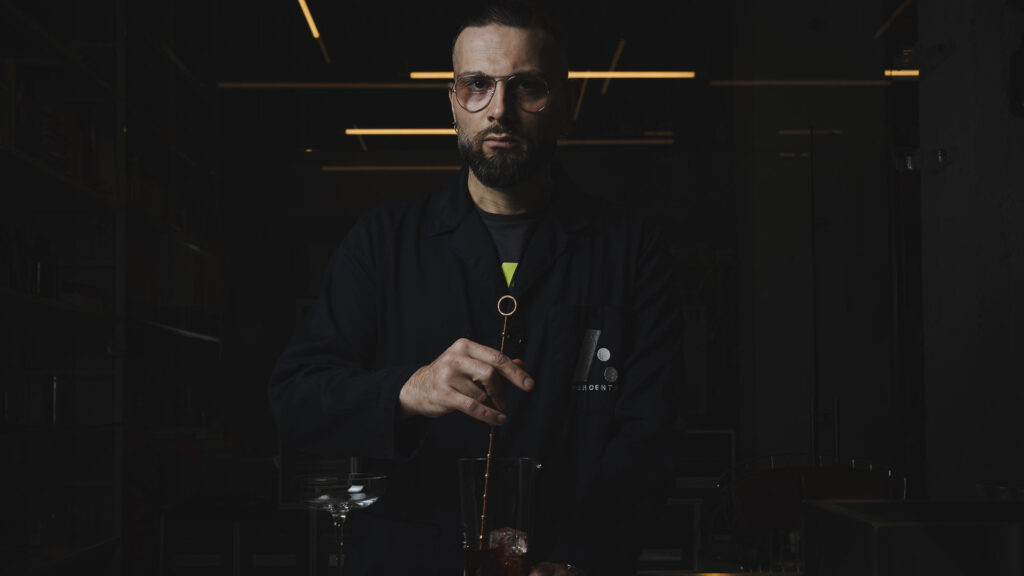
Alongside ice comes the work on liquids: light distillations, redistillations, low-temperature reductions. Bucur is careful to clarify the point. “We intervene on a distillate when there is a need to rework a product, lighten it, shift its aromatic axis. So we redistill it.” The comparison to tailoring comes naturally. “It is like taking in a shoulder or shortening a sleeve. The garment remains the same, but it changes how it sits.”
At the lab, Bucur also works on menu engineering, which arrives as a finishing step. “First you prepare the fabric,” he jokes. “Then you decide the cut — putting together a complete project that holds identity of the bar, economic sustainability and quality of service together.” Percento supports bartenders and brands in developing signatures and drink lists, often for competitions or new projects. “The drink has to hold up under repetition. If it does not, you go back. You unpick everything and start again,” he says, smiling. When the conversation turns to the future, the tone becomes serious. “Behind the bar, you need passion — but also balance.”
Training is changing pace, accelerating, becoming more and more digital. “We still believe in being present, even if we know the world is moving in another direction. Some things cannot be compressed.” Time, for Bucur, remains the most important measure. “It is the only resource you cannot get back.”
The article first appeared on Coqtail – for fine drinkers. Order your copy here
Photo by Emanuel Florentin x Coqtail. All rights reserved